
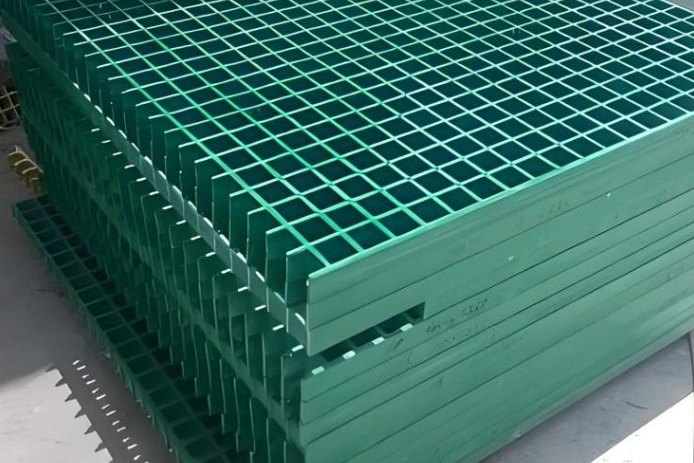
A pulp and paper mill is one of the few environments where an FRP specification can fail for being too conservative in one place and not conservative enough in another, sometimes on the same walkway. Chlorine dioxide bleaching drains the colour out of a steel handrail in a single shutdown; hot white liquor at a hundred degrees attacks a resin that handles ambient caustic perfectly well; and a continuous washdown that keeps the grating clean also keeps the top surface permanently wet, which changes the slip requirement entirely. This guide sets out the chemicals zone by zone, the resin selection that follows from them, a span and load check showing how little structural margin a 38 millimetre panel has at a 1200 millimetre support spacing, and a twenty-year lifecycle comparison against hot-dip galvanised steel that puts a number on the case for FRP without overstating it.
1. Why a Mill Is Harder Than a Chemical Plant
Chemical plants generally handle one family of chemistry and can position access platforms away from the worst of it. A mill handles several aggressive chemistries within sight of each other, at temperatures that vary from ambient to above a hundred degrees, in a humid and permanently wet atmosphere, and with continuous washdown. Five conditions stack up:
- Oxidising bleach chemistry. Chlorine dioxide, hypochlorite and chlorine are present together in the bleach plant, and each attacks a different part of the resin chemistry.
- Hot alkali. Caustic soda and white liquor run hot, and the combination of high pH and elevated temperature degrades resin systems that are perfectly adequate cold.
- Continuous moisture. The paper machine area is a permanent fog. Nothing dries, and any exposed glass edge is wetted continuously.
- Washdown. Water at pressure drives contaminants into every joint, and it also carries away the surface layer of any coating, which is why coatings fail early here.
- Mechanical abuse. Forklift traffic, dropped tools, dragged pumps and the impact of a felt roll being craned past an access platform. An FRP structure has to survive all of it, not just the design load.
2. The Chemicals, Zone by Zone
The first step in specifying anything in a mill is mapping where it will stand, because the same material is right in one area and wrong a hundred metres away.
| Zone | Principal chemicals | Temperature | What it demands |
|---|---|---|---|
| Bleach plant (D stage) | Chlorine dioxide, sulphuric acid, steam | 50 to 80 C | The most aggressive area on most sites; vinyl ester throughout, with sealed edges and no exposed fasteners |
| Bleach plant (C and E stages) | Chlorine, caustic soda | 40 to 70 C | Vinyl ester; phenolic only where a fire rating is also required |
| Recovery and causticising | White liquor, green liquor, lime mud, hot caustic | 90 to 110 C | Resin temperature limit is the governing property, not chemical resistance |
| Paper machine wet end | Dilute chemistry, high humidity, continuous water | Ambient to 60 C | Slip resistance is the governing requirement; grip has to be moulded in |
| Paper machine dry end | Heat, steam, machine oil | Up to 110 C | Temperature limit and thermal expansion; FRP expands two to three times as much as steel |
| Stock preparation | Dilute process water, occasional chemicals | Ambient to 50 C | Impact resistance from dropped stock; deeper panels rather than larger spans |
| Effluent and clarifiers | Hydrogen sulphide, dilute acid and alkali | Ambient | Vinyl ester where H2S is present; the H2S also attacks the steel reinforcement in concrete |
Reading the table from top to bottom, the requirement migrates from chemical resistance to temperature resistance and then to slip resistance. A single resin choice across the whole mill is either over-specified in the effluent area or under-specified in the bleach plant, and it is almost always the second.
3. Resin Selection
The resin matrix, not the glass, determines the chemical resistance, and the three options are not interchangeable.
| Resin | Bleach chemistry | Hot caustic | Fire performance | Where it belongs in a mill |
|---|---|---|---|---|
| Isophthalic polyester | Poor for sustained exposure | Moderate; marginal above 50 C | Flame-retardant grades available at Class 2 | Stock preparation, effluent areas, general walkways away from bleach |
| Vinyl ester | Excellent, including wet chlorine dioxide and hypochlorite | Good | Flame-retardant grades available at Class 1 | The default for the bleach plant, recovery, causticising and any wetted chemical area |
| Phenolic | Moderate | Moderate | Best available; Class 0 achievable with very low smoke | Only where a fire rating is mandatory and the chemicals are mild; more brittle and more costly |
Vinyl ester typically costs twenty to thirty-five per cent more than isophthalic polyester for the same panel, and in the bleach plant it is not optional. In the effluent area it is usually unnecessary. The specification error that costs the most is applying an isophthalic panel in a bleach plant because the load table was identical: the panel carries the load perfectly well right up until the resin degrades, and by then the walkway has been signed off and forgotten.
Two secondary selections matter almost as much. The glass content should be at least 30 to 40 per cent by mass; a cheap panel at 20 per cent is mostly resin and fails under concentrated loads well before its load table suggests. And the fire rating should be stated as a flame spread index rather than as the word fire retardant, which has no defined meaning.
4. Span, Load and Deflection
The load table is the first thing that gets replaced by a rule of thumb, and the consequences are arithmetic. Taking a 38 millimetre moulded panel rated at 5.0 kilonewtons per square metre over a 900 millimetre span at a deflection limit of span over 200, the flexural rigidity implied by that rating is about 9.5 kilonewton square metres per metre width. The actual duty then follows directly.
| Live load | Total with self-weight | Support spacing | Deflection | Limit | Verdict |
|---|---|---|---|---|---|
| 2.5 kN/m2 | 2.85 kN/m2 | 900 mm | 2.56 mm | 4.50 mm | OK |
| 2.5 kN/m2 | 2.85 kN/m2 | 1000 mm | 3.91 mm | 5.00 mm | OK |
| 2.5 kN/m2 | 2.85 kN/m2 | 1200 mm | 8.11 mm | 6.00 mm | Over |
| 4.0 kN/m2 | 4.35 kN/m2 | 900 mm | 3.91 mm | 4.50 mm | OK |
| 4.0 kN/m2 | 4.35 kN/m2 | 1000 mm | 5.97 mm | 5.00 mm | Over |
| 5.0 kN/m2 | 5.35 kN/m2 | 900 mm | 4.81 mm | 4.50 mm | Over |
The pattern is steep because deflection varies with the fourth power of the span. Going from 900 to 1200 millimetres at a modest walkway load more than triples the deflection and takes the panel from comfortable to unacceptable without changing the reported load rating at all, because the rating was quoted at the shorter span. The practical rules that follow for a mill are:
- Support spacing should align with the panel length so that a panel is supported at every beam, not cut down to fit an arbitrary grid.
- Where the duty load is above about 4 kN per square metre, increase the panel depth rather than reducing the span; a 50 millimetre panel at 1200 millimetres is a better solution than a 38 millimetre panel at 900 millimetres for both access and cost.
- Concentrated loads from a forklift wheel or a dropped tool are not covered by a uniformly distributed load rating, and they should be assessed separately.
5. Washdown, Slip Resistance and Hygiene
A mill walkway is wet most of the time, and a slip resistance figure quoted dry is worthless. The requirement is the wet value, and it should be a specified number rather than a claim.
- Moulded-in grit, not a coating. In moulded grating the anti-slip grit is embedded in the top layer during the moulding, so it cannot be worn or washed off. In pultruded grating the grit sits on the surface and wears away over five to ten years of heavy traffic.
- Wet values in the range 0.60 to 0.80 are typical for a grit-surfaced moulded panel, tested by ASTM E303 or EN 13036; the exact requirement depends on the walkway's slope and on whether it is a work platform or an access route.
- Concave or open surfaces drain. A closed or deeply pocketed profile holds liquid and stays slippery; a moulded grid drains through the mesh, which is a large part of why the mesh form is used at all.
- Hygiene requirements conflict with grit. Where food-contact or cleanroom cleanliness is required the grit surface is a problem, and a smooth panel with a specified wet slip value is the alternative. Mills rarely have this constraint outside a converting area.
Continuous washdown also has a structural consequence: it keeps the grating permanently wet, which keeps any exposed cut edge permanently exposed to whatever the wash water carries. Sealing every field-cut edge is not a cosmetic step in a mill.
6. Lifecycle Cost Against Galvanised Steel
The case for FRP grating is usually made on corrosion, and it should be made on money, because the corrosion argument does not by itself tell a purchasing department how much extra to pay. Using an installed cost of USD 103 per square metre for FRP against USD 70 for hot-dip galvanised steel, with the steel requiring a recoat at USD 12 every five years and replacement at year twelve:
| Year | FRP spend | FRP cumulative NPV | Steel spend | Steel cumulative NPV |
|---|---|---|---|---|
| 0 | 103.00 | 103.00 | 70.00 | 70.00 |
| 5 | 0.00 | 103.00 | 12.00 | 78.97 |
| 10 | 0.00 | 103.00 | 12.00 | 85.67 |
| 12 | 0.00 | 103.00 | 70.00 | 120.46 |
| 15 | 0.00 | 103.00 | 12.00 | 125.46 |
| 20 | 0.00 | 103.00 | 0.00 | 125.46 |
Discounted at six per cent over twenty years, FRP comes to 103.00 per square metre against 125.46 for steel, a difference of 22.46 or about 22 per cent. Three observations make that number honest rather than optimistic:
- The crossover is late. Steel is cheaper for the first ten years. A project with a five-year horizon, or a mill with a short remaining life, is not automatically wrong to buy steel.
- The advantage is concentrated in the replacement event. Almost all of the difference arises at year twelve, when the steel grating is replaced. If the real service life of the steel is longer than twelve years, or the real life of the FRP is shorter than twenty-five, the gap narrows quickly.
- None of the maintenance cost is downtime. The comparison counts only materials and labour. In a bleach plant, gaining access to a walkway to recoat it costs more in lost production than the coating does, and that cost is not in the table.
The argument for FRP grating in a mill is not that it is cheaper. It is that the twenty-year cost is lower and, more importantly, that the maintenance never has to happen in an area where access is the expensive part. A maintenance task that cannot be scheduled is not a cost, it is a risk.
7. Structures, Not Only Grating
Grating is the most visible FRP in a mill and rarely the most heavily loaded. The supporting structure, the handrails, the ladders and the cable containment carry the loads and they have their own requirements.
- Pultruded profiles for the framing. Beams, columns and bracing from pultruded FRP give the same corrosion performance as the grating with far better structural efficiency than trying to build supports from panels.
- Handrails and ladders are compliance items. Guardrail heights and ladder cage geometry are governed by occupational safety rules, and an FRP system should be specified to the same dimensions as a steel one rather than to a supplier's catalogue.
- Cable containment in a bleach plant. An FRP cable tray is non-conductive and immune to the chemistry, which matters where a steel tray would corrode through and drop cables onto a walkway.
- Fire stopping. An FRP structure itself needs a fire strategy. Where a cable transit passes through a fire-rated wall or floor, the penetration has to be sealed with a rated barrier regardless of what the tray is made of.
- Thermal movement. FRP expands two to three times as much as steel for the same temperature change. A long continuous handrail or tray run between two fixed structures will find the weakest connection unless an expansion detail is provided.
8. Inspection and Condition Monitoring
FRP does not rust, which is exactly why it goes uninspected. The failure modes that do occur are slow and mostly invisible from a walkway:
- Resin degradation of the top surface. Look for a change in colour, a chalky or fibrous surface, or glass becoming visible. In the bleach plant this is the first indicator that the resin is being attacked.
- Edge and cut-edge condition. Any cut edge with exposed glass and no seal is a starting point for moisture ingress and, in a wet chemical area, for delamination.
- Grit wear. The moulded grit wears more slowly than a coating, but heavy traffic routes wear faster than the rest. Measure the wet slip value on the traffic route rather than on a sample.
- Fixings and clips. The grating is usually still sound when the clips that hold it down have corroded. Metal fixings are the most common cause of FRP grating movement.
- Support condition. Check that the supports have not deflected and that the spans have not been increased by a modification.
- Temperature excursions. Any event that took a walkway above the resin's temperature limit is a reason to inspect, because the damage from a single over-temperature event can exceed years of normal service.
9. FAQ
Can the same grating be used in the bleach plant and the effluent area? It can physically be installed in both, but specifying one grade for both means paying vinyl ester prices in the effluent area or accepting premature failure in the bleach plant. The second outcome is far more common, and it is invisible until it is advanced.
Does vinyl ester solve a temperature problem? Partly. Vinyl ester has a higher heat distortion temperature than polyester, so it extends the useful range, but the limit is still a resin property and the hot white liquor areas are governed by temperature rather than chemistry. Above the practical limit, the answer is a different structure, not a different resin.
Is FRP grating safe for a walkway carrying forklifts? Only where the panel depth and the support spacing have both been checked against a concentrated wheel load, which a uniformly distributed load rating does not cover. The usual solution is a deeper panel on a closer support grid.
How often should grating be replaced? The panel is generally the last thing to fail. In practice walkways are renewed when the supporting structure, the clips or the handrails have reached the end of their life, or when a change in process chemistry has invalidated the original resin choice.
Can FRP be used inside a pressure or vacuum vessel in a mill? Yes, as internals, but that is a different design case with its own requirements, and the resin selection has to be made for the vessel's actual chemistry rather than carried over from the walkway specification.
10. Specifying FRP Across a Mill
At Henan HuanGang we supply high-density moulded FRP grating for the chemical industry alongside the pultruded profiles, handrails, ladders and cable containment that go with it, in isophthalic, vinyl ester and phenolic resin systems. Send us a zone-by-zone list of what the grating will see — the chemical, the concentration, the temperature and the washdown regime — and we will come back with the resin for each area, the panel depth and the support spacing that the duty actually needs, and the accessory list. If a single grade genuinely covers your whole site, we will tell you that too, and it will be a smaller quotation than you were expecting.
Related reading: FRP grating versus steel grating on total cost of ownership, FRP grating load tables, moulded versus pultruded grating, resin selection for FRP, slip resistance of FRP stair treads, fire resistance and flame spread, grating and handrail condition assessment, FRP handrail systems, FRP ladders and access systems, FRP cable tray in corrosive environments, FRP in mining and mineral processing and FRP profiles in wastewater treatment.
Need help selecting FRP products?
Our engineers answer technical questions free of charge.
Ask an Engineer on WhatsApp