
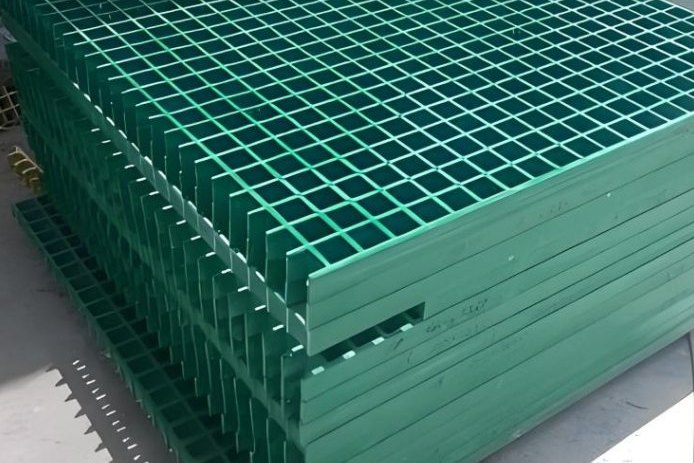
An offshore or coastal platform deck is the one place where three requirements that normally pull in opposite directions all have to be satisfied at the same panel: it must survive salt water for decades, it must stay walkable when it is permanently wet and often oily, and it must not become the reason a person cannot get off the structure in a fire. A chemical plant walkway can be optimised for one of those. A marine deck cannot. This guide works through the standard set that actually governs FRP grating and profiles in marine service, the corrosion arithmetic that explains why steel access decks are replaced on a cycle rather than maintained indefinitely, the load, deflection and slip numbers to put in a specification, the fire integrity levels used by classification societies, and the fastening and inspection details that decide whether a deck lasts twenty-five years or five.
1. Why a Marine Deck Is Not Just a Wet Chemical Plant
Most FRP walkways are specified from experience in chemical plants, water treatment works or cooling towers, and that experience transfers only partially. Marine exposure differs in four ways that matter to the specification.
- Continuous chloride, not intermittent splash. In an ISO 9223 C5 or CX environment, chloride is deposited every day and the surface is wet for a large fraction of the year. There is no drying cycle to interrupt the corrosion of anything metallic, and there is no drying cycle to protect the wet slip performance of the walking surface either.
- The splash zone is the worst place on the structure. Above and below water, corrosion rates are lower than at the splash zone, where wetting, aeration, abrasion from wave action and biological activity peak. Access decks are normally in or just above that band.
- Maintenance is discretionary and expensive. Nobody shuts a production platform down to repaint a walkway. Inspection and replacement happen during planned campaigns, so a material that needs paint every five years is effectively a material that will be left to degrade.
- Weight and access drive cost. Every kilogram has to be lifted, and every panel has to pass through a handrail gap. This is where FRP stops being a corrosion upgrade and becomes the cheaper option.
The consequence is that the specification rarely fails on the resin data sheet. It fails on the details: the cut edge that was never sealed, the stainless clip that was tightened until the resin beneath it cracked, or the panel that met the ambient deflection limit but not the fire case the classification society requires.
2. Corrosion Arithmetic: What Steel Actually Does Here
ISO 9223 classifies atmospheric corrosivity from C1 to CX using the first-year corrosion rate of standard coupon metals. For carbon steel the published first-year rates are:
| Category | Typical environment | Carbon steel, first year | 25-year section loss (power law, b = 0.6 to 0.8) |
|---|---|---|---|
| C3 medium | Coastal area with low salinity | 25 to 50 µm/year | 0.17 to 0.66 mm |
| C4 high | Coastal area without direct salt spray | 50 to 80 µm/year | 0.34 to 1.05 mm |
| C5 very high | Shoreline exposed to surf, high humidity | 80 to 200 µm/year | 0.55 to 2.63 mm |
| CX extreme | Offshore platform, splash zone, high time of wetness | 200 to 700 µm/year | 1.38 to 9.19 mm |
Two things follow. First, in the CX band a bare steel bearing bar of five millimetres is consumed within the design life of the platform, not at the end of it: at a first-year rate of 200 µm and a time exponent of 0.6, cumulative loss reaches 1.38 mm in 25 years, and at 700 µm the same calculation gives 4.83 mm, which is the whole bar. Second, and less obviously, the low rate at the start is what makes the problem invisible. A deck that looks acceptable after three annual inspections is already in the regime where section loss is irreversible.
Cathodic protection and coatings change the arithmetic but not the conclusion. A hot-dip galvanised deck in a C5 marine site has a finite zinc budget, and the published zinc first-year rates in that category are 4.2 to 8.4 µm, so the coating is a ten to twenty year consumable rather than a finish. On a structure where recoating means scaffolding over water, that is the whole business case.
On a marine structure the question is not whether steel will corrode, it is whether you can reach the steel to maintain it before it does. If the answer is no, the material choice has already been made for you.
3. The Standards That Actually Govern Marine FRP Grating
Two standards dominate and they are not interchangeable. ASTM F3059 was written for shipyard and marine construction use, and ISO 24681:2023 was written for the marine industry generally, covering self-supporting FRP gratings for pedestrian pathways and platforms on ships and offshore platforms. Around them sit the access, slip and fire rules that classification societies and port authorities enforce.
| Standard | What it covers | Where it applies |
|---|---|---|
| ASTM F3059-24 | Full performance specification: deflection limits, ultimate failure of assembled grating, wheel loading, impact resistance, skid resistance, durability, UV, salt spray, surface flammability and structural fire integrity, referenced to a 94 lbf/ft² (4.5 kN/m²) steel grating equivalence | Shipbuilding and marine construction purchase specifications, US Coast Guard equivalency submissions |
| ISO 24681:2023 | Structure, technical requirements and test methods for FRP gratings: classification of moulded and pultruded types, appearance and porosity limits, load and deflection criteria, seawater and salt-fog resistance, skid resistance, fire performance, anti-electrostatic provisions | Ship and offshore platform paths and platforms, international procurement |
| EN ISO 14122-2 | Working platforms and walkways: uniformly distributed and concentrated load, deflection, clear width and headroom, openings and toe boards | Access design on machinery and industrial installations, including offshore topsides |
| IMO FTP Code, 2010 edition | Fire test procedures: Part 5 surface flammability, Part 2 smoke and toxicity | Any grating in an enclosed space on a vessel or unit in SOLAS scope |
| IACS UI SC 253 | Fire resistance requirements for FRP gratings used for safe access to tanker bows, referencing the FTP Code and recognised structural fire integrity standards | Tankers and gas carriers, from keel laid 1 January 2013 (Revision 1 applies to ships contracted on or after 1 January 2017) |
| DIN 51130 and ASTM D2047 | Slip resistance of walking surfaces: R9 to R13 classification, and static coefficient of friction by James machine | Slip specification and project handover testing |
| OSHA 29 CFR 1910 Subpart D | Walking-working surfaces: platform loading, guarding, openings | US-flagged facilities and shoreside installations |
The practical point is that a supplier claiming "offshore grade" is claiming very little. Ask which of these standards the panel was tested to, what the test report number is, and whether the tests were type tests on a generic panel or tests on the actual panel construction, depth and resin you are buying. F3059 in particular attaches its performance to an assembled panel at a qualified span, not to a coupon.
4. Resin Selection: Isophthalic, Vinyl Ester, Phenolic or Epoxy
Seawater is not a single chemical; it is a chloride solution with a pH of roughly 7.8 to 8.4, an oxygen supply that never stops, and a temperature that peaks in the splash zone. All four common resin families handle it, but they diverge sharply once the deck is also exposed to hydrocarbons, fire risk or high temperature.
| Resin | Seawater resistance | Continuous service temperature | Fire behaviour | Use it when |
|---|---|---|---|---|
| Isophthalic polyester, fire retardant | Good; standard choice for general access decks | Around 90 to 100 C | ASTM E84 Class 1 achievable with FR fillers; burns with smoke | Open, non-hazardous decks where cost matters and fire integrity is not required |
| Vinyl ester | Excellent; the default for offshore and hydrocarbon service | Around 100 to 110 C | Class 1 with FR grade; still produces smoke | Any deck over water in a production or process area, and all splash-zone work |
| Phenolic | Good | Up to around 150 to 180 C depending on grade | Self-extinguishing, low smoke and low toxic emission; the only family that can be certified to the marine fire integrity levels | Enclosed spaces, escape routes, firefighting access, lifeboat embarkation areas |
| Epoxy | Good | Highest of the four | Usually the weakest fire performance; not for escape routes | Solvent exposure, high temperature lines, and specialist chemical duty |
Two material details sit underneath the resin choice. The first is the reinforcement: E-glass is not inert in water. Under sustained wet service, alkali and chloride ions migrate into the fibre and sodium and hydroxyl ions migrate out, which is why an FRP laminate that is never allowed to dry needs a resin-rich surface and an intact gel coat or surfacing veil, not just a good resin. Water absorption measured to ASTM D570 is the cheapest single indicator, and specification limits of about 0.5 % or less are normal for marine grades.
The second is the surface layer. Grit is broadcast into the top surface during moulding, or bonded to a pultruded panel, and the grit-bearing layer is by definition resin-rich and therefore the first thing to lose its gloss and its colour. That is cosmetic until the fibres beneath it are exposed, at which point the panel is on a countdown. Panels with a surfacing veil under the grit hold their appearance and their wet slip value noticeably longer than those without.
Three selection rules follow, and they are worth writing into the purchase inquiry rather than leaving to the quotation stage:
- Name the environment, not the word marine. A deck 200 m inland from a harbour and a deck in the splash zone are different corrosivity categories with different resin expectations, and a supplier who knows which one you are in will propose the cheaper adequate grade.
- Separate the areas by duty. It is common and sensible to use a standard fire retardant isophthalic panel on open, low-risk walkways and a phenolic panel only on escape routes, stair towers and areas a firefighting crew has to cross.
- Require the surface to be specified as well as the panel. Grit type, grit size, whether a surfacing veil is included behind it, and whether nosing bars are supplied are all part of the slip performance and none of them appear in a resin data sheet.
5. Load and Deflection: The Criteria a Marine Deck Must Meet
EN ISO 14122-2 sets the floor for a working platform: a load-bearing structure that carries a uniformly distributed load of at least 2.0 kN/m², a concentrated load of at least 1.5 kN applied over a 200 mm by 200 mm area, deflection under the design load that does not exceed 1/200 of the span, a clear width of 800 mm (1000 mm where people pass in both directions) and 2100 mm of headroom. It also requires openings small enough that a 35 mm sphere cannot pass, a 20 mm limit where people are working rather than passing, and a maximum step of 4 mm between adjacent floor elements.
ISO 24681 is stricter in places, which is why it matters for offshore work: it specifies a minimum flexural strength of 345 MPa for the grating, a mid-span deflection limit of span/120 with an absolute cap of 9 mm for platform panels, and a stair tread assessment under a 2 kN concentrated load with a deflection limit of span/200 and a 6 mm cap.
The distinction between these limits is not academic, because deflection, not strength, decides the support spacing on a pedestrian deck. Compare the governing limits at typical spacings:
| Support spacing | L/200 (EN ISO 14122-2) | L/120 (ISO 24681) | ISO 24681 absolute cap | Limit that actually governs |
|---|---|---|---|---|
| 600 mm | 3.00 mm | 5.00 mm | 9 mm | 3.00 mm |
| 900 mm | 4.50 mm | 7.50 mm | 9 mm | 4.50 mm |
| 1200 mm | 6.00 mm | 10.00 mm | 9 mm | 6.00 mm |
| 1500 mm | 7.50 mm | 12.50 mm | 9 mm | 7.50 mm |
| 1800 mm | 9.00 mm | 15.00 mm | 9 mm | 9.00 mm |
Read that table against a span/deflection chart and the design consequence is immediate. A 38 mm moulded panel in an isophthalic or vinyl ester resin typically holds the L/200 criterion at support spacing in the 600 to 900 mm range under a 2 kN/m² pedestrian load. Past that, a pultruded FRP walkway grating panel with I-bar bearing bars is the correct answer, because its stiffness per unit weight is several times higher and its bearing bars are aligned in one direction, which also lets you orient the panel to the load path. Do not accept a supplier's span table without checking which of the two criteria, and which load, it was built from; a span table based on a 1.5 kN/m² occasional-access load and one built on the ISO 24681 case are different documents.
On a marine deck, strength rarely governs and stiffness almost always does. If you have sized the panel on strength, you have sized it wrongly.
6. Slip Resistance: R Classes, Coefficient of Friction and What Fails Wet
Slip is the failure mode that actually injures people offshore, and it is measured three different ways depending on the market. DIN 51130 classifies a walking surface tested with oil on an inclined plane from R9 to R13. ASTM D2047 measures the static coefficient of friction of a surface with a James machine. Pendulum tests such as ASTM E303 report a slip resistance value or pendulum test value on a wet surface. ISO 24681 requires an average coefficient of friction of at least 0.75 on the upper surface in the dry condition, and ASTM F3059 sets its skid requirement in the same region, above 0.75 by D2047.
| Method | Output | Typical specification for an offshore deck | Comment |
|---|---|---|---|
| DIN 51130 | R9 to R13 classification, tested with oil on a ramp | R12 minimum for wet walkways, R13 for oily or greasy zones | Best single number for a procurement document in European practice |
| ASTM D2047 | Static coefficient of friction | 0.75 or higher on the delivered surface | Referenced by both F3059 and ISO 24681 |
| ASTM E303 / pendulum | Wet slip resistance value | Project-specific; used for handover and periodic re-test | Useful for tracking grit wear over the life of the deck |
Three things degrade the number after commissioning, and all three are predictable. Marine biofilms and algae form a slick layer on any grit surface that is wet most of the time, which is why cleaning regime matters as much as the panel specified. Hydrocarbon and lube oil films do the same thing faster, and no grit grade compensates for a pool of oil. And the grit itself wears away, fastest at stair nosings and at the point where a forklift or trolley wheel turns. That is why nosing bars and pre-formed stair treads with sacrificial grit surfaces are worth specifying rather than fabricating treads from flat panel.
7. Fire Integrity: What the Classification Society Will Ask For
Fire is where the marine requirement separates itself from every other FRP application. A tanker must give the crew a way to reach the bow in severe weather, and since 1 July 1998 SOLAS has required that walkway to be constructed of fire resistant and non-slip material. IACS Unified Interpretation SC 253 then tells surveyors what that means for FRP: the grating must show low flame spread and must not generate excessive quantities of smoke and toxic products in accordance with the 2010 FTP Code, and must demonstrate adequate structural fire integrity against a recognised standard, citing ASTM F3059 or the equivalent US Coast Guard acceptance level as examples.
Structural fire integrity under ASTM F3059 is a tiered rating, and the tiers determine where the grating may be used:
| Level | Intended use | Fire exposure and residual performance |
|---|---|---|
| L0 | No fire integrity claimed | No E119 fire test performed; suitable only where no fire case applies |
| L3 | Egress routes and areas that may need access for firefighting, rescue or emergency operations during or just after a transitory fire | Preloaded sample must not deflect more than L/10 in the first 18 minutes of the E119 exposure and must not collapse for the remainder of the one-hour test |
| L2 | Open deck areas where groups assemble, including temporary safe refuge and lifeboat embarkation areas | L3 requirements plus a post-fire load test carrying 94 psf (4.5 kN/m²) for 15 minutes |
| L1 | Escape routes and access for firefighting, emergency operation or rescue after a significant fire incident | L2 requirements plus impact testing of surviving samples per ASTM E695 |
The surface flammability test sits alongside the fire integrity test. In ASTM F3059 practice, four panel samples are tested to ASTM E84 in both orientations, coated and uncoated, with acceptance criteria in the region of a flame spread index of 20 or less and a smoke developed index of 450 or less; ISO 24681 accepts a flame spread index of 25 or less and the same smoke developed index, or the equivalent IMO FTP Code Part 5 result, with smoke and toxicity assessed under Part 2 where the space requires it.
Two boundaries belong in the specification, because claiming more than the standard delivers is a common and expensive mistake. ASTM F3059 explicitly does not address the ability of a grating to carry moving or stationary equipment during or after a fire, and it addresses fire conditions based on the E119 cellulosic curve only, not hydrocarbon pool or jet fires. If the design case on your asset is a jet fire or a hydrocarbon pool fire, the grating specification is not the right instrument; you need a passive fire protection design assessed against a jet fire test regime, and the grating decision becomes secondary to the structural steel protection beneath it.
An L2 phenolic grating and a Class 1 vinyl ester grating can both be sold as fire rated. Only one of them satisfies an escape route requirement. Ask for the level, not the phrase.
8. Panel Type, Bearing Direction and Support Detailing
Moulded and pultruded grating solve different problems in marine service, and most offshore decks use both.
| Property | Moulded grating | Pultruded grating |
|---|---|---|
| Load distribution | Bidirectional, because the bars interlock in both axes | Unidirectional along the bearing bars; the tie bars carry very little |
| Stiffness at equal depth | Lower | Typically two to three times higher, so longer spans are possible |
| Corrosion performance | Uniform, since the resin surrounds the bars on all faces | Good, but cut ends and drilled holes expose the glass-resin interface and must be sealed |
| Where it earns its place offshore | Small platforms, stair treads, irregular shapes, areas cut around penetrations | Long walkway runs, decks with vehicle or trolley loads, stringer-supported platforms |
Three detailing rules follow from that table. First, pultruded panels must be laid with the bearing bars aligned to the direction of the load path, which in practice means perpendicular to the supporting stringers. Second, cut ends and drilled holes on any panel must be sealed with catalysed resin, because an unsealed cut edge is the only place on a pultruded panel where water can reach the glass directly. Third, F3059 practice caps the gap between a panel and the adjacent structure at about 6 mm and requires the panels to be restrained; a panel that can move, chatter or lift is a panel that will eventually lose its edge condition and its grip.
9. Fixings: The Detail That Decides the Service Life
FRP does not corrode, but the hardware that holds it down does. In a high-chloride environment the correct default is 316L stainless for light duty and a duplex grade such as 2205 where the deck sees cyclic loading, standing seawater or high temperature. Stainless steels protect themselves with a passive film, and that film needs oxygen; a fastener sitting in a wet crevice between two panels, or in the gap between the panel and a steel stringer, is exactly where pitting and crevice corrosion start. The practical mitigations are simple: keep fasteners out of standing water, use a washer that spreads the bearing load without collecting water, use isolating washers or a gasket where the grating sits directly on steel so that the steel below does not become a crevice corrosion site, and never couple stainless to bare carbon steel in a wet zone.
The load case for the fixings is rarely calculated, and it should be. Take a standard marine panel 1.22 m by 3.66 m, which is 4.47 m². A modest uplift or underside pressure of 1.0 kPa on that panel gives 4.47 kN, or about 1.12 kN on each of four clips. That is small, but the clip is doing something a bolt is bad at: holding a brittle material in tension. So the design rules are about distribution and compression, not just capacity:
- Four fixings per panel minimum where the panels are not mechanically connected to each other, with additional hold-downs where the panel edge is exposed to uplift.
- Hold-down spacing of roughly 300 to 450 mm along support lines in high-vibration areas such as pump decks and pipe racks, which for a 3.66 m panel means nine to thirteen clips per supported edge.
- Torque to the manufacturer's figure, typically in the region of 15 to 20 N·m for M10 hardware. Over-torquing crushes the resin-rich surface within the bearing area and creates the crack that starts delamination. A washer plate or a moulded pultruded clip saddle spreads the load.
- Slotted or oversized holes where panels span between fixed supports, so that thermal movement is taken by the panel sliding rather than by a cracked hole.
10. The Verification Package to Ask For
The cheapest way to control quality on an FRP deck is to make the supplier commit to a test list before the order is placed. Marine acceptance is built on retest-after-exposure logic: the panel is aged, then re-tested for the property that matters, which is much more informative than a coupon test on new material.
| Property | Test | Typical acceptance | What it protects against |
|---|---|---|---|
| Salt spray durability | ASTM B117 or ISO 9227 salt fog | 7 days exposure followed by flexural retest to the same criteria as new material; ISO 24681 uses the same retest logic against ISO 14125 | Resin that performs in a data sheet but hydrolyses in service |
| Ultraviolet resistance | ASTM D4329 or ISO 4892-3 | 720 hours with no fibre exposure | Surface degradation before the design life, particularly on unfaced surfaces |
| Abrasion | ASTM D4060 Taber | Substrate not reached before roughly 1200 cycles | Premature loss of the grit-bearing surface |
| Skid resistance | ASTM D2047 or DIN 51130 | 0.75 coefficient of friction, or R12 to R13 | A deck that meets the number on a dry laboratory panel only |
| Surface flammability | ASTM E84, four samples, both orientations | Flame spread index around 20 or less, smoke developed index 450 or less | Resin systems sold as fire retardant that fail the smoke criterion |
| Structural fire integrity | ASTM E119 with preload and post-fire load | Declared L1, L2 or L3 with the qualified span stated | Fire ratings asserted without a level, a span or a test report |
| Water absorption | ASTM D570 | Typically 0.5 % or less for marine grades | A resin-rich surface that is only skin deep |
Insist that the report states the panel construction, thickness, mesh, resin, surfacing and the qualified span, and that the certificate identifies the panel you are buying. On a marine project the inspecting authority will ask, and a generic type test on a different panel depth is not an answer.
11. Inspection, Defect Grading and Repair Offshore
A marine deck fails in a sequence, and each stage is visible long before it matters. Grading defects into three bands lets you tie the inspection result to an action instead of an argument.
| Grade | What it looks like | Action |
|---|---|---|
| Green | Surface chalking, colour fade, grit partly worn, fastener heads sound | Clean and record. Re-test slip resistance at the next scheduled survey |
| Amber | Exposed fibre at cut edges, white or brown surface bloom, grit missing over a walking line, loose clip after torque check, silicone or sealant missing | Seal cut edges with catalysed resin, re-torque or replace clips, restore the grip surface, treat the location as an inspection point at every subsequent survey |
| Red | Delamination indicated by a dull tone on hammer tapping, cracking through the bearing bars, a panel that moves underfoot, through-hole corrosion of the support steel revealed by a panel that has shifted | Replace the panel. On a structural panel over water, treat this as a priority work item rather than a snag |
Three habits make the difference between a deck that reaches its design life and one that does not. Seal every cut edge, including the ones made during installation by a contractor who has run out of time. Re-check the torque on clips once after six months and then annually, because compression relaxation in the panel is real and a loose clip is the origin of almost every panel that has been found moving. And keep the grit clean: a biofilm that has been on the surface for two years will not release in a rain shower, and its slip coefficient is not the one on the certificate.
12. Writing the Specification
Most of the value in this article can be captured in a purchase order clause of a few lines. Something along these lines is worth copying, checking and then adapting to your own loading case:
FRP grating for the splash zone and open deck access shall be vinyl ester or phenolic resin, moulded or pultruded as scheduled, tested as an assembled panel to ASTM F3059-24 with ISO 24681:2023 as the supplementary marine reference. Declared structural fire integrity level: L2 minimum for open deck assembly areas and L1 for escape routes and firefighting access; surface flammability flame spread index 20 or less and smoke developed index 450 or less, tested to ASTM E84 in four orientations. Skid resistance R12 minimum by DIN 51130 and 0.75 minimum coefficient of friction by ASTM D2047. Salt spray per ASTM B117 for seven days followed by flexural retest to the new-material acceptance criteria. Water absorption 0.5 % maximum by ASTM D570. Panels shall be delivered with all cut edges sealed; hold-down clips, stainless steel grade 316L or duplex 2205, four per panel minimum with additional clips at 450 mm maximum centres on exposed edges; nosing bars at all stair treads and walkway edges.
That paragraph costs nothing to write and it removes the two most common causes of a failed marine deck: an unspecified fire level, and a grip surface that nobody tested wet.
At Henan HuanGang we manufacture moulded FRP walkway grating, high-density moulded grating for aggressive service, anti-slip class 1 fire resistant grating with custom cutting, pultruded grating and the handrail, ladder, stringer and cable containment profiles that go with them, in isophthalic, vinyl ester and phenolic systems. Send us the deck plan, the environment and the fire level you have to meet, and we will come back with the panel type, depth, resin and support spacing the duty requires, together with the test documentation the inspecting authority will ask for. If a lower-cost grade covers part of your deck, we will say so and price it that way.
Related reading: fire resistance and flame spread of FRP grating, FRP versus steel grating on total cost of ownership, moulded versus pultruded grating, reading a grating load table, field cutting, edge sealing and clip fixing, machining FRP profiles and grating, grating and handrail condition assessment, FRP handrail systems, ladders and access systems to OSHA and EN ISO 14122, resin selection for chemical equipment, UV weathering and colour stability, pultruded cable tray in corrosive environments and FRP in desalination and brine service.
Need help selecting FRP products?
Our engineers answer technical questions free of charge.
Ask an Engineer on WhatsApp